 ALCYON
Science · Norovirus
Norovirus: active and passive immunity, and how they differ
Norovirus establishes infection at the intestinal epithelium. The useful question is therefore not what circulates in the blood, but what is present in the gut lumen, and when it gets there.
Passive: oral IgY
Ready-made avian antibodies, designed to be present locally in the gut lumen across a defined exposure window.
Read the passive arm → ExploratoryActive: OMV-displayed antigen
Presenting a designed antigen so that the immune system would mount, and remember, its own response.
Read the active arm →01 · The problem
Why norovirus is an intestinal problem
Where it acts
Norovirus infects cells of the intestine. Material that reaches the gut lumen in functional form is present at that site without needing systemic absorption.
How it spreads
Norovirus spreads readily from person to person, through contaminated food, water and surfaces, and a very small number of particles can be enough to start an infection.
Source: US Centers for Disease Control and Prevention, norovirus overview.
Why closed settings differ
On a voyage, a ward or a barracks, the exposure window is bounded and known in advance. In that setting, how quickly something is present matters more than how long it lasts.
The operational view. In a closed setting, an outbreak is first an operational event: rotas, cabin and ward capacity, cleaning cycles, itineraries and reputation. This page is written for the people who carry that responsibility.
02 · The core distinction
Active and passive immunity are not the same thing
Active immunity is what your own immune system builds after it meets an antigen. It takes time and it can be remembered. Passive immunity is antibodies made elsewhere and handed over ready to work. It needs no build-up and leaves no memory.
| Property | Active immunity | Passive immunity |
|---|---|---|
| What is given | An antigen | Ready-made antibodies |
| What the body does | Mounts its own response and forms memory | Nothing: the antibodies are borrowed |
| Onset | Weeks | On arrival at the site of action |
| Duration | Months to years | Days, only while the material is present |
| Repeat dosing | Boosters, infrequent | Dosed across the exposure window |
| Immunological memory | Yes | No |
| Alcyon arm | OMV-displayed antigen Exploratory | Oral IgY Core |
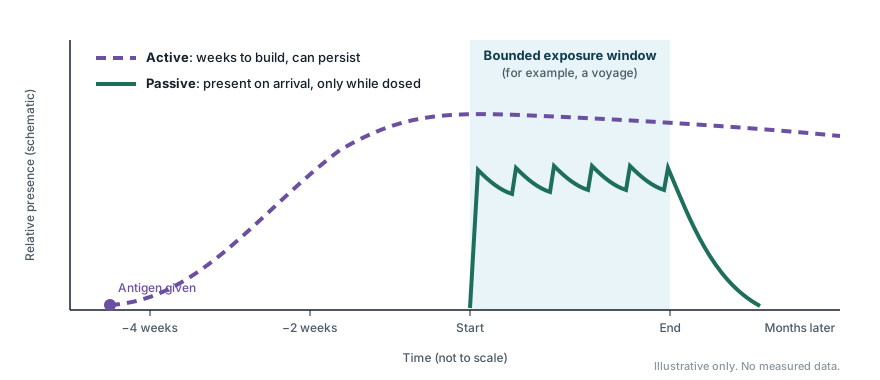
Note. Passive immunity is not a vaccine and is not a substitute for one.
03 · The passive arm
The passive arm: IgY Core programme
What IgY is
Immunoglobulin Y is the main antibody class in birds and the avian counterpart of mammalian IgG. It is produced by immunised laying hens and transferred into the egg yolk, from which it is recovered. That allows production at scale from eggs rather than from bled animals. Taken by mouth, it is intended to act locally in the intestinal lumen rather than in the bloodstream.
Egg allergen. IgY is recovered from egg yolk and is therefore an egg-derived material. It is not intended for people with egg allergy.
The working chain
Select a step for detail.
Step 1Antigen selection & design
Choosing and designing the antigen that hens are immunised with. This is where specificity and breadth are intended to be set.
Step 2Hen immunisation
Laying hens are immunised with the designed antigen on a defined schedule.
Step 3Differentiated polyclonal repertoire
The hen produces many antibodies against different parts of the antigen, rather than a single clone.
Step 4IgY recovery from yolk
Antibody is separated from the yolk, with processing designed to keep binding function and not only protein mass.
Step 5Oral formulation & delivery
The antibody is built into protected particles intended to pass the stomach.
Step 6Functional material in the lumen
The design goal: antibody that still binds when and where it is released in the intestine.
Antigen design sits upstream of everything else. The antigen chosen is intended to determine the specificity and breadth of the resulting polyclonal preparation, so it is a source of differentiation in its own right, not merely an input borrowed from vaccine work.
- Antigen selection and design
- Functional IgY
- Protected oral delivery
Norovirus is the selected first indication at the centre of these three capabilities.
Protected oral delivery
An antibody taken by mouth faces three separate losses. They act on different properties of the molecule, and protecting against one does not protect against the others:
Gastric loss
Denaturation and protein digestion at low pH in the presence of pepsin.
Process loss
Wetting, shear and drying can leave the molecule intact as protein mass while the antigen-binding site loses its shape.
Storage loss
Aggregation and unfolding driven by residual moisture and molecular mobility in the solid state.
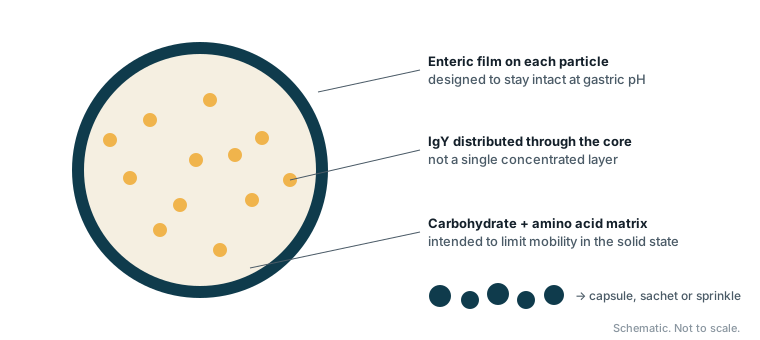
Why the barrier is on each particle, not on the capsule
A coating on the container is a single point of failure. If the capsule shell cracks, is chewed, or is opened to sprinkle onto food, the whole dose loses its gastric barrier at once.
A film on each particle is designed to keep that barrier independent of the presentation. The same particles can be filled into a capsule, packed in a sachet or sprinkled, and each one still carries its own film. Release is also spread across many small units rather than one.
Technical and IP summaries are available on request. Contact us.
04 · The active arm
The active arm: OMVs Exploratory
Exploratory. Every statement in this section is conditional. No preclinical or clinical work is claimed.
What an OMV is
Outer membrane vesicles are nanoscale vesicles shed from the outer membrane of Gram-negative bacteria. They carry membrane-associated components and are studied as antigen-display platforms with built-in adjuvant properties.
OMVs are already used in a licensed vaccine in another indication: the meningococcal group B vaccine 4CMenB contains an OMV component. Reference to be confirmed before publication.
Why it is interesting here
An OMV would be one route to presenting a designed norovirus antigen to the mucosal immune system. It would draw on the same upstream antigen-design capability that feeds the IgY arm, so work done there may serve both arms.
What is not yet established
- Antigen format
- Construct design
- Route
- Dose
- Immunogenicity
- Safety
- Manufacturing
All of these are open questions.
Status. Active immunisation is not the immediate product strategy. Knowledge generated through antigen selection may support later investigation of it.
05 · Combining the arms
How the two arms fit together
A bounded, known window
Oral IgY is designed to be present across a bounded exposure window that is known in advance, with an onset that does not depend on weeks of immune build-up.
Recurrent exposure
An active approach would be relevant where exposure is recurrent and longer-lasting. It depends entirely on the exploratory arm described above.
The two answer different questions. Which one fits depends on how long the exposure window is, and how far in advance it is known.
06 · Evidence design
How function is measured
No results are reported on this page. These endpoints describe how evidence will be generated. The programme's data are prospective.
Mass recovered is not function recovered. A preparation can release antibody protein in full and still have a reduced capacity to block attachment. A single "percent released" figure cannot tell those two cases apart.
Physical recovery
How much material is released, and in which compartment.
Retained specific potency
Blocking potency per unit mass recovered, compared with a time-zero control from the same batch, run on the same occasion by the same analyst.
Functional dose recovery
E1 and E2 combined, reported across the intestinal window rather than at a single end point.
The three endpoints are always reported separately and never collapsed into one number.
The transit test
An acid stage with pepsin, a transition in the same vessel, then an intestinal stage with bile salts and pancreatin. It is a comparative method for discriminating between formulations tested in parallel. It is not a validated simulation of human gastrointestinal delivery.
The attachment-blocking assay
Specific to genotype and variant. GII.4 and GII.17 conditions are reported separately and never pooled.
Limitation. This assay does not establish neutralisation, mucosal immunity, prevention, treatment, symptom reduction or reduced viral shedding. A result supports only the exact condition tested.
07 · Settings
Where a bounded exposure window matters
Cruise and closed settings
A voyage is a defined window. An outbreak has operational and reputational consequences for the operator, who may be the economic beneficiary rather than the individual passenger.
What we would need to validate: outbreak economics, who buys and who pays, and which claims are permitted.
Travel
Some travellers may prefer an oral format to an injection. This is a commercial hypothesis, not a finding.
What we would need to validate: stated preference and willingness to pay.
Institutional and deployment settings
Value depends on how long a deployment lasts and on actual exposure, so this setting needs segmenting before any conclusion.
What we would need to validate: segmentation by duration and exposure.
08 · Regulatory
Regulatory position, and what we do not claim
The route under investigation is a food-supplement-first strategy. It is not confirmed, and it remains subject to review by qualified regulatory counsel.
We make no claim that any Alcyon product prevents, treats, cures or reduces the risk of norovirus infection or of any other disease. Nothing on this page is medical advice. Availability, if any, varies by jurisdiction.
09 · Programme
Programme status
Antigen selection
Choosing and designing norovirus antigens for hen immunisation, with GII.4 and GII.17 in scope.
IgY generation & characterisation
Immunisation, yolk recovery and binding characterisation of the resulting polyclonal IgY.
Formulation & transit testing
Protected particles, assessed with the two-stage transit test and endpoints E1 to E3.
Evidence package
A consolidated, reviewable dataset to support regulatory and partner discussions.
What would move this forward: laboratory partners for antigen production and hen immunisation, and seed funding for the first IgY batches. Talk to us.
10 · FAQ
Questions we are asked
Is this a vaccine?
No. A vaccine drives active immunity: the body's own response and its own memory. IgY is passive. The antibodies are made by hens, and no immunological memory is formed.
How quickly would it act, and for how long?
Mechanistically, passive material can only act where and while it is present, and it stops when it is cleared. We will not give timing figures until evidence exists.
I am allergic to eggs. Could I take it?
IgY is recovered from egg yolk, so the material is egg-derived. It is not intended for people with egg allergy.
Is it approved?
No. There is no product on the market and no regulatory authorisation. The programme is at the research and development stage.
Why hens rather than mammals?
Antibody is recovered from egg yolk. That allows production at scale from eggs collected in the normal way, without bleeding animals.
What is an OMV, and why is it on this page? Exploratory
An outer membrane vesicle is a nanoscale vesicle shed by Gram-negative bacteria and studied as an antigen-display platform. It is the exploratory active-immunisation arm described above. It is not the immediate product strategy.
Where can I read the technical detail?
Technical and intellectual-property summaries are available to partners, investors and collaborators on request. Use the contact form and choose the route that fits.
Contact
Talk to us
For cruise and institutional partners, investors, and scientific collaborators or candidates. Choose a route and we will send your message to the right person.